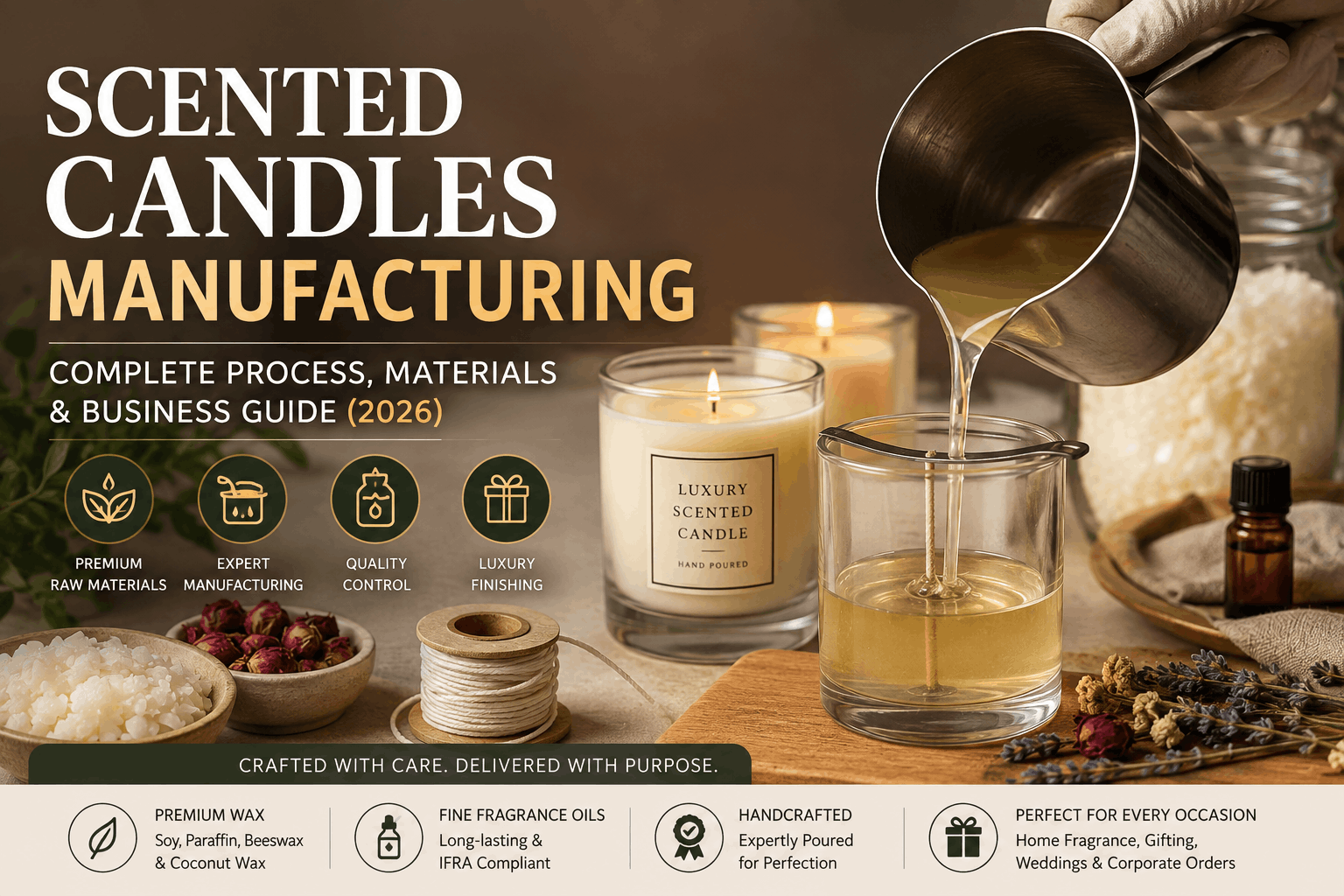


Scented candles have transformed from a simple household item into a symbol of luxury, relaxation, and thoughtful gifting. Whether lit during a quiet evening at home, gifted at a wedding, or handed out as part of a corporate hamper, a well-made scented candle carries craftsmanship in every drop of wax and every note of fragrance. But behind that soft flicker and calming aroma lies a detailed manufacturing process that blends science, art, and quality control.
In this guide, we break down exactly how scented candles are manufactured — from raw material sourcing to the final packaged product — and explore why this industry has become such a fast-growing business opportunity in India and globally.
Scented candle manufacturing is the process of combining wax, fragrance oils, wicks, dyes, and containers to create candles that release a pleasant aroma when burned. It’s a precise process — temperature control, fragrance load, wick selection, and curing time all directly affect the candle’s scent throw, burn time, and overall quality.
At Rajasvi Decor, every candle goes through this careful process to ensure that each piece meets a premium, gift-worthy standard before it reaches a home, hotel, or corporate event.
The quality of a scented candle begins with the quality of its raw materials. Here’s what goes into a well-made candle:
The base material, and arguably the most important decision in the entire process:
Concentrated scent oils that are blended into the melted wax, typically at 6–10% of the wax weight. Fragrance selection plays a huge role in customer experience — brands often help buyers discover their signature fragrance before choosing a candle.
Cotton, wood, or braided wicks that determine how evenly and cleanly the candle burns.
Wax-safe dyes used to give candles their signature look — from soft pastels to bold, statement colors used in Sculptural & Shaped Candles.
Glass jars, ceramic pots, tins, or silicone molds, depending on whether the final product is a jar candle, Pillar Candle, or a Tealight Candle.
Wax is melted in a double boiler or industrial melting tank at a controlled temperature, usually between 60–80°C depending on the wax type used.
Once the wax reaches the correct melting point, fragrance oil and dye are added. Timing and temperature matter here — adding fragrance too early or at too high a temperature can cause the scent to evaporate, weakening the final “scent throw.”
Wicks are pre-fixed into the container or mold using wick stickers or centering devices to keep them straight during pouring.
The scented wax mixture is carefully poured into containers or molds at a specific temperature to avoid air bubbles, sinkholes, or uneven surfaces — a critical step for premium jar candles.
Candles are left to cool at room temperature, then cured for 24–72 hours. Curing allows the fragrance oil to fully bind with the wax, which is what gives a candle a strong, long-lasting scent throw once lit.
Wicks are trimmed to the standard length (around 6mm), containers are cleaned, and any imperfections are corrected.
Each batch is checked for burn time, scent strength, appearance, and safety compliance before moving to packaging — a step every reputable candle manufacturer in India takes seriously.
Finished candles are labeled with fragrance name, burn instructions, and safety warnings, then packed — whether for retail shelves, e-commerce shipping, or corporate & bulk gifting orders.
While artisanal, handcrafted candles are often made manually, larger-scale manufacturing units use:
Many businesses start with manual, small-batch production — much like handcrafted luxury brands — and scale to semi-automatic or fully automatic machinery as demand grows.
With rising demand for home fragrance, wellness, and premium gifting products, scented candle manufacturing offers strong business potential — from small home-based studios to large export-scale factories. Popular business models in this space include:
For the end customer, all of this manufacturing detail translates into a simple experience: does the candle smell good, burn evenly, and last as long as promised? That’s why brands that pay attention to sourcing, wax selection, and curing time — rather than cutting corners — build long-term trust with buyers looking for luxury scented candles or luxury jar candles for their homes and gifting needs.
Scented candle manufacturing is where craftsmanship meets chemistry. From selecting the right wax and fragrance oil to mastering the pouring temperature and curing time, every step shapes the final product a customer lights in their home. Whether you’re a business exploring candle manufacturing, or simply a candle lover curious about the process, understanding these steps helps you appreciate — and choose — better quality candles.
Explore Rajasvi Decor’s full range of handcrafted, premium candles in our shop, or get in touch for wholesale, export, and corporate bulk gifting enquiries.
Q1. What is the best wax for scented candle manufacturing? Soy wax and coconut wax are popular for their clean burn and strong scent throw, while paraffin wax remains a cost-effective option for mass production. Premium brands often use soy or coconut wax for their luxury scented candles collections.
Q2. How much fragrance oil should be added to candle wax? Typically 6–10% of the total wax weight, depending on the wax type and desired scent strength.
Q3. What is “scent throw” in candle making? Scent throw refers to how strongly a candle’s fragrance spreads through a room — both when unlit (“cold throw”) and while burning (“hot throw”).
Q4. How long does it take to manufacture scented candles? Pouring and cooling usually take a few hours, but curing time (24–72 hours) is needed for full fragrance development before the candle is ready to sell.
Q5. Is scented candle manufacturing profitable as a business? Yes — it has relatively low starting investment, strong margins, and consistently growing demand, making it a popular choice for small businesses, D2C brands, and even export-focused manufacturers.
Q6. What machines are needed to start candle manufacturing? At a small scale, a wax melter, pouring jugs, and thermometers are enough. For bulk production, filling machines, cooling tunnels, and labeling machines are used.
Q7. Where can I buy high-quality manufactured scented candles in India? You can explore handcrafted, premium scented candles at Rajasvi Decor, which offers everything from jar candles to pillar candles and corporate gifting solutions.
Discover luxury candle inspiration, elegant décor ideas, fragrance tips, gifting trends, and exclusive collection updates delivered to your inbox.
No spam, only beautifully curated inspiration. Unsubscribe anytime.